
Last updated: August 2026
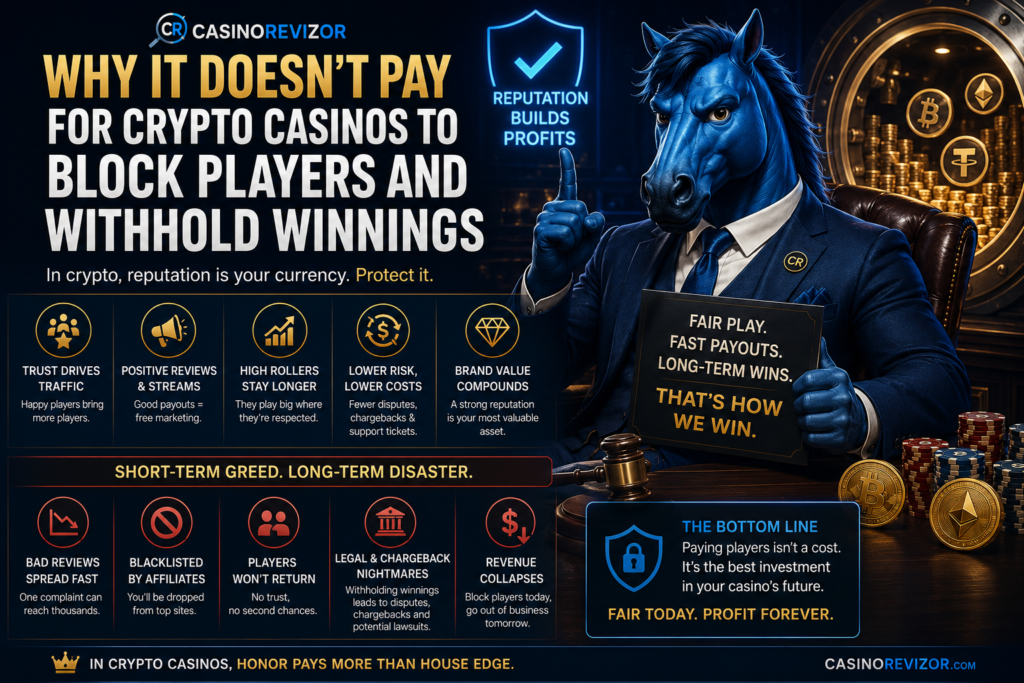
Every player who’s ever had a big win has felt the same flash of worry: will they actually pay me, or will they just freeze my account? It’s a fair fear — but if you understand how a crypto casino actually makes money, you’ll see why blocking a legitimate winner is one of the worst business decisions an operator can make. This guide explains the economics honestly: why the house doesn’t need to cheat to win, why losing a player is expensive, why account problems are almost always about KYC rather than theft, and exactly how to get a stuck withdrawal moving — including the one piece of leverage every player actually has.
We’ll also be straight about the exception: rogue casinos do exist, and the economics below only protect you if you’re playing at a real, reputable operator. Choosing the right site is the whole game.
Key takeaways
- The house already wins over time. The maths (RTP / house edge) means the casino profits from the average player without touching a single payout.
- Acquiring you was expensive. Operators pay heavily in affiliate commissions, bonuses and marketing to get you through the door — nuking a verified winner throws that money away.
- The market is crowded and competitive. Hundreds of crypto casinos compete for the same players; no serious operator wants a payout scandal.
- Account freezes are almost always KYC, not theft — often triggered on larger withdrawals (commonly in the low thousands of USDT), even at “no-KYC” sites.
- Your leverage is reputation. Honest reviews on portals like CasinoRevizor drag down a casino’s rating, ranking and revenue — which is exactly why support tends to move once a complaint goes public.
Why trust this explanation
We review crypto casinos for a living, and our judgement is grounded in real testing:
- We deposit and withdraw ourselves. Our top pick, Vave, is a site we funded with real crypto and cashed out from — our Tested pick; everything else we cover is clearly labelled Detailed Analysis.
- We track payout reputation. How an operator handles withdrawals is the single biggest factor in our rankings.
- No pay-to-rank. Our ratings aren’t for sale — which is exactly why they carry weight when a casino misbehaves.
The house already wins — so why would it cheat?
Start with the thing most players never fully internalise: a casino doesn’t need to withhold winnings to make money, because the maths already guarantees its profit over time.
Every game has a built-in house edge — the small percentage the casino keeps on average. Its mirror image is RTP (return to player), the percentage paid back over millions of bets. A slot with 96% RTP keeps roughly 4% of everything wagered, forever.
| Game type | Typical RTP | House keeps (edge) |
|---|---|---|
| Popular online slots | ~96% | ~4% |
| Blackjack (basic strategy) | ~99% | ~1% |
| Roulette (European) | ~97.3% | ~2.7% |
| Crash / instant games | ~97–99% | ~1–3% |
Here’s the key point for a worried winner: individual sessions are random — you absolutely can win big — but across the whole player base and enough time, the edge does the work. The casino’s profit is the aggregate of thousands of players, not any single result. A verified winner cashing out is simply the system working as designed; the house has already made its margin on the crowd. Refusing to pay doesn’t protect the business model — the business model was never at risk.
This is why the phrase “in the long run, the house always wins” is literally true — and why it removes any need to cheat. An operator that pays every legitimate win still profits handsomely.
Getting you through the door was expensive
Now the part players rarely see: acquiring a single real-money player is one of the biggest costs in the entire industry. Operators spend heavily before you’ve placed a single bet:
- Affiliate commissions. Most players arrive via affiliates, who are typically paid 25–50% revenue share for the lifetime of the player, or a large one-off CPA. That’s an ongoing cut of everything you generate.
- Welcome bonuses and free spins. Real money handed out up front to convert you.
- Marketing, sponsorships and retention. Ads, streamers, VIP hosts, reloads, rakeback — all spent to get and keep you.
| Cost to acquire and keep a player | Why it matters |
|---|---|
| Affiliate revenue share (25–50%, lifetime) | The casino only profits if you keep playing |
| Sign-up bonus / free spins | Sunk cost paid before you deposit |
| Marketing & sponsorship spend | High cost-per-acquisition per real player |
| VIP perks, rakeback, reloads | Ongoing spend to retain you |
Put those two facts together and the logic is stark. The casino has already spent real money to acquire you, and it profits from you only over the long run, where the house edge grinds out its margin. Freezing a verified winner to dodge one payout doesn’t just create a scandal — it destroys the future value of a player they paid to acquire. It’s setting money on fire to avoid handing over change.
A crowded market where nobody wants to lose players
There are now hundreds of crypto casinos competing for the same pool of players, and switching costs for a player are almost zero — a new wallet address and you’re playing somewhere else in minutes. In that environment, reputation is the entire moat.
- A single credible “they didn’t pay me” thread can cost an operator far more in lost sign-ups than the withheld amount.
- Players share payout experiences constantly — on review portals, forums, Reddit, Discord and Telegram.
- Affiliates drop casinos that generate complaints, because a bad payout reputation kills their conversions too.
In a competitive market, a serious operator’s incentive is to be known for paying fast — that’s a selling point, not a cost. The rogue move (withhold and hope) only makes sense for a fly-by-night site with no future to protect, which is exactly the kind of site this guide will help you avoid.
So why do accounts actually get frozen? Usually KYC
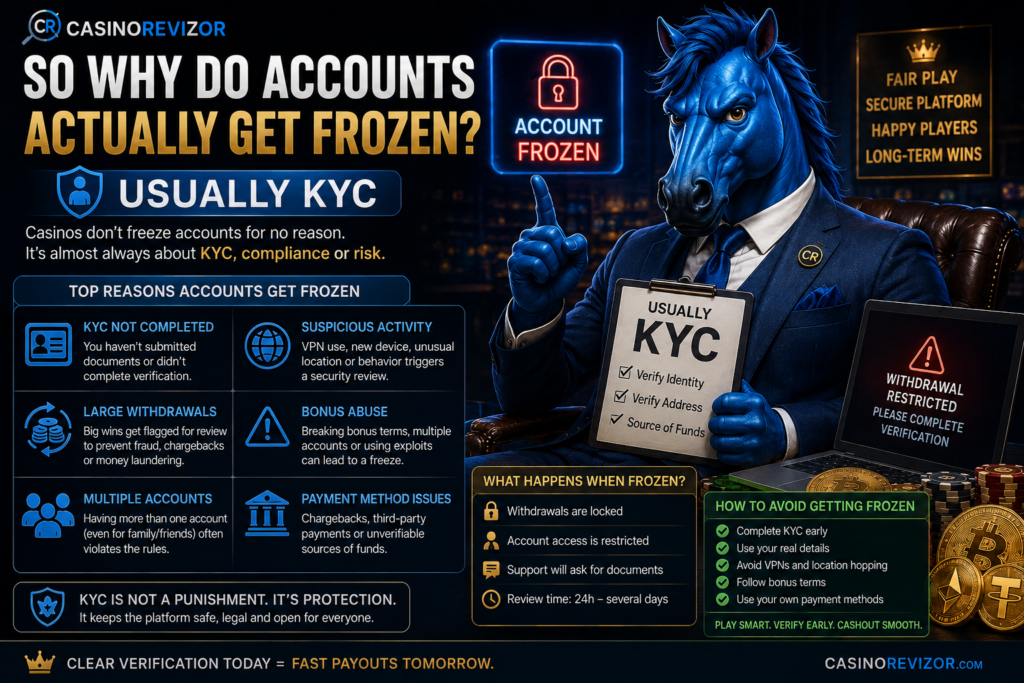
Here’s the honest reality behind most “they blocked me” stories: the account wasn’t stolen from — it was paused for verification. Under anti-money-laundering (AML) rules, even crypto-first operators have to be able to verify who’s cashing out, especially on larger sums.
- KYC commonly triggers on bigger withdrawals — frequently somewhere in the low thousands of USDT (you’ll often see figures cited around the equivalent of a few thousand). Thresholds vary by operator and by the AML regime they follow.
- Yes, this includes “no-KYC” sites. “No-KYC” really means no checks to start. Try to withdraw a large win and verification can still appear — that’s the honest meaning of the label, and we say so on our no-KYC casinos guide.
- Other legitimate reasons for a hold: bonus-abuse checks, multiple accounts, playing from a prohibited country, or mismatched payment details. These are T&C issues, not the casino “stealing” a win.
The takeaway: a frozen withdrawal is usually a process, not a robbery. And once you clear it, the incentive flips entirely in your favour.
Once you’re verified, legitimate winnings get paid
This is the reassuring part, stated honestly. For a reputable operator, a fully verified account with legitimately-won funds is almost always paid — because, as we’ve seen, there’s no upside in doing anything else. They’ve already made their margin on the crowd, they paid to acquire you, and they can’t afford the reputational hit.
The honest caveat: “almost always” is not “always.” Payment can still be legitimately refused where terms were genuinely broken (bonus abuse, multi-accounting, fraud, banned jurisdiction). And a truly rogue casino can behave badly regardless of logic. That’s why choosing a proven site up front matters more than any dispute process after the fact.
How to get a stuck withdrawal moving
If a payout stalls, work the steps in order — most cases resolve at step 1 or 2:
- Complete KYC properly. Send exactly what’s asked — clear ID, proof of address, and payment/source-of-funds if requested. Blurry or mismatched documents are the No. 1 cause of delay.
- Contact support in writing. Open a ticket or live chat, stay factual and calm, and keep every reference number. Ask for the specific reason and the expected timeline.
- Be realistically patient. Verification can genuinely take 24–72 hours, sometimes longer for large sums. A delay isn’t proof of bad faith.
- Escalate inside the casino. Ask for a complaints/compliance manager or a VIP host if you have one.
- Then use your real leverage: go public. If they stall or stonewall without a valid reason, leave an honest, factual review on independent portals — CasinoRevizor and other reputable review/complaint sites (Trustpilot, AskGamblers, Casino Guru). Stick to facts, dates and amounts; a calm, verifiable account carries far more weight than an angry rant.
Why an honest review is such powerful leverage
This is the mechanism the user rarely sees, and it’s why step 5 works:
- Public ratings feed the rankings. On review and comparison portals, a casino’s score shapes where it appears in listings.
- Lower rating → lower ranking → fewer clicks. Slip down the list and the flow of new players dries up.
- Fewer players → less revenue. In a business where acquisition is expensive and margin comes from volume, a reputation hit costs far more than almost any single payout.
That’s the whole point of the article: the casino’s rational self-interest is to pay you and keep its rating clean. A public complaint threatens the one thing it can’t easily rebuild — its reputation — which is exactly why support so often “finds a solution” once a legitimate complaint becomes visible. It’s not magic; it’s economics.
(A fair-play note: this leverage exists to resolve genuine disputes, not to threaten a casino over a payout that was legitimately declined. False or extortionate reviews are unfair, easy to see through, and undermine your own credibility.)
The honest exception: rogue casinos exist
We won’t pretend every operator is reputable. A minority of sites are built to grab deposits and vanish, and no amount of economic logic binds them. Protect yourself before you deposit:
- Choose sites with a real payout record — the single most important signal, and the reason we lead with a tested pick.
- Prefer provably-fair games you can verify cryptographically rather than “trust us” RNG.
- Read the withdrawal and bonus terms before you play, not after you win.
- Check independent reviews across more than one portal.
- Start with sites we’ve actually tested, like our Vave review — the one we funded and withdrew from ourselves. Play Now
Frequently asked questions
Will a crypto casino block me just to avoid paying my winnings? A reputable one has every reason not to. It already profits from the house edge over time, it spent money to acquire you, and it can’t afford a payout scandal in a crowded market. Most “blocks” are actually KYC holds, not refusals.
Why do casinos ask for KYC if they’re “no-KYC”? “No-KYC” means no checks to start playing. AML rules still require verification for larger withdrawals — commonly in the low-thousands-of-USDT range — so verification can appear when you cash out a big win.
At what amount does KYC usually kick in? It varies by operator and the AML regime they follow, but it’s frequently triggered somewhere around the equivalent of a few thousand USDT. Treat any specific number as a rough guide, not a guarantee.
My withdrawal is stuck — what should I do? Complete KYC exactly as asked, then contact support in writing and get a reason and timeline. Be patient for 24–72 hours, escalate to compliance/VIP if needed, and if they stonewall without a valid reason, leave an honest, factual review on CasinoRevizor and other reputable portals.
Do reviews actually change anything? Yes. Ratings feed rankings, rankings drive new sign-ups, and sign-ups are the casino’s revenue. A credible public complaint threatens the reputation the operator depends on — which is why legitimate disputes often resolve once they’re visible.
Does the casino really win in the long run anyway? Statistically, yes — the house edge means the operator profits across the whole player base over time, even while individuals win. That’s precisely why it doesn’t need to withhold legitimate payouts.
Can a payout ever be legitimately refused? Yes — genuine bonus abuse, multiple accounts, fraud, or playing from a prohibited country can void winnings under the terms. That’s different from a rogue site simply refusing to pay.
How do I avoid rogue casinos in the first place? Choose operators with a documented payout record, provably-fair games, clear terms, and consistent independent reviews. Starting with sites that have been deposit-tested is the safest route.
Responsible gambling
Understanding that reputable casinos pay winners is not a reason to chase them. Remember the maths cuts both ways: the same house edge that lets a casino pay honestly is what makes gambling a losing proposition for the average player over time. Set deposit and loss limits before you play, treat it as entertainment rather than income, and never chase losses. 18+. If gambling is causing harm, free confidential support is available — in the UK, GamCare / 0808 8020 133 and BeGambleAware.org; elsewhere, your national helpline.
Conclusion
The fear that a crypto casino will block you to keep your winnings is understandable — but it runs against the operator’s own self-interest. The house already wins over time, it paid real money to acquire you, and in a market of hundreds of competitors it can’t afford a payout scandal. Account problems are almost always KYC, and once you’re verified, a reputable site has every reason to pay. If one ever stalls unfairly, your leverage is real: an honest review lowers its rating, its ranking and its revenue. Choose proven sites, verify early, keep records, and play within limits you set in advance.
Informational only, not legal or financial advice. 18+. Please gamble responsibly.

By Alex Ivers — crypto-gambling reviewer, CasinoRevizor · Fact-checked by the CasinoRevizor editorial team ·