By Alex Ivers — crypto-gambling reviewer, CasinoRevizor · Fact-checked by the CasinoRevizor editorial team
Last updated: August 2026

If you play at high stakes, the online casino world has quietly split in two. On one side are standard, locally-licensed casinos, where regulators increasingly cap how much you can stake per spin, how fast you can play, and how much you can deposit. On the other are crypto casinos, which sit outside those national caps entirely. For a high roller, that difference isn’t a detail — it decides whether you can actually play your game.
This guide does three things: it explains, honestly, why crypto casinos suit high rollers better than standard ones; it reviews country by country where standard online casinos restrict stakes, spins and deposits (with a link to our dedicated crypto-casino guide for each); and it lays out every practical advantage crypto has over the standard model. As always, we lead with what we’ve actually tested — and with the trade-offs, not just the upside.
Key takeaways
- Standard casinos increasingly cap high-stakes play — per-spin stake limits, minimum spin times, and monthly deposit ceilings are now common across Europe.
- Crypto casinos aren’t bound by those national caps — higher limits, faster large withdrawals, real VIP.
- The restrictions are country-specific — we break down the UK, Germany, Netherlands, Belgium, Spain, Sweden, Norway, Australia, Switzerland, Canada and New Zealand below.
- Every country block links to our crypto-casino guide for that market, so you can see the offshore alternative.
- The trade-off is real — offshore crypto casinos aren’t locally licensed, so payout reputation is your protection. Vave is the one we’ve deposit-tested.
Why trust CasinoRevizor
A quick word on where we stand, because on a high-stakes topic it matters:
- We test before we publish. We fund accounts with real crypto and complete withdrawals. Of the casinos we cover, Vave is our deposit-Tested pick; everything else is Detailed Analysis — serious research, clearly labelled.
- No pay-to-rank. Placement isn’t for sale.
- We publish the trade-offs. Offshore play means giving up local consumer protection — we say so in every country block.
- We cite real regulation. The country limits below come from the actual rules (UKGC, Germany’s GGL, Belgium’s Gaming Commission, Spain’s DGOJ and others), not guesswork.
What makes a casino genuinely good for high rollers

Before the country breakdown, here’s the checklist a high roller should actually judge a site by:
| Factor | Why it matters at high stakes |
|---|---|
| Maximum bet / spin | A hard per-spin cap decides how you play |
| Withdrawal ceiling | Can you take a six-figure win out in one go? |
| Payout speed | Minutes vs several working days |
| Deposit freedom | No monthly/weekly cap throttling your bankroll |
| VIP substance | Real rakeback, a named host, fast limit increases |
| Liquidity & reputation | Deep enough to pay a whirlwind win, with the record to prove it |
| Verification | KYC handled proactively, not sprung on a big cashout |
Standard casinos are now built around the average player. Crypto casinos, at VIP level, are built to keep high-stakes players. That’s the whole story — the rest of this guide is the evidence.
Why crypto casinos beat standard casinos for high rollers
Here’s the head-to-head that matters most at serious stakes:
| What a high roller wants | Standard (locally-licensed) casino | Crypto casino |
|---|---|---|
| Per-spin stake ceiling | Capped by law (€1–€5 / £5 typical) | No statutory cap |
| Deposit limits | Weekly/monthly caps in many countries | Set by you, not the state |
| Large withdrawals | Staged over days, sometimes capped | Often same-day, six figures possible |
| Withdrawal speed | 1–5 working days | Minutes to hours on-chain |
| Affordability paperwork | Triggers at modest losses | Minimal until large withdrawals |
| VIP / loyalty | Modest, tightly controlled | Rakeback, dedicated host, real perks |
| Payment friction | Card blocks, no credit cards in some markets | Crypto bypasses card rails entirely |
| Spin speed | Minimum spin times (2.5–5s) enforced | Play at your own pace |
| Privacy | Full identity tied to all play | Pseudonymous, lower footprint |
| Game access | Live/table games restricted in some markets | Full global library |
The short version: standard casinos cap you; crypto casinos don’t. Now let’s show exactly where — and how much — the standard model caps you, country by country.
Where standard online casinos restrict high rollers — country by country
Different countries limit online casino play in different ways: some cap the stake per spin, some the speed of play, some your deposits, and a few restrict the market so heavily that offshore is the only realistic option. In each block below you’ll find the real restriction and a link to our crypto-casino guide for that market, where those caps don’t apply.
At-a-glance table:
| Country | Main high-roller restriction on standard casinos | Crypto casino capped the same way? | Our guide |
|---|---|---|---|
| United Kingdom | £5/spin (£2 for 18–24), affordability checks, no credit cards | No | UK crypto casinos » |
| Germany | €1–€5/spin tiers, 5-sec spins, €1,000/month deposit cap | No | Country legality guide » |
| Netherlands | Mandatory deposit limits, lower for 18–24s | No | Country legality guide » |
| Belgium | €200/week deposit limit, age 21 | No | Country legality guide » |
| Spain | €600/day, €1,500/week, €3,000/month deposit caps; no bonuses | No | Spain crypto casinos » |
| Sweden | Mandatory limit-setting, one-bonus rule, Spelpaus | No | Country legality guide » |
| Norway | State monopoly, monthly loss limits, payment blocking | No | Country legality guide » |
| Australia | Online casino games banned outright (IGA 2001) | No | Australia crypto casinos » |
| Switzerland | Only ~10 licensed sites; offshore DNS-blocked | No | Switzerland crypto casinos » |
| Canada | Provincial rules; Ontario limits bonuses/inducements | No | Canada crypto casinos » |
| New Zealand | New licensing regime (in force 1 May 2026), ad limits | No | New Zealand crypto casinos » |
United Kingdom — £5 a spin and affordability checks
The UK is now one of the tightest markets for a high roller. Standard UKGC-licensed casinos apply a maximum online slot stake of £5 per spin (£2 for players aged 18–24), enforce minimum spin speeds (2.5 seconds) with no autoplay, turbo or quick-spin, and run financial-risk / affordability checks that can trigger around £150–£500 in net monthly losses, sometimes requesting bank statements. Add the 2020 credit-card ban and staged withdrawals, and the standard UK casino is built around the average player, not you.
The crypto alternative: offshore crypto casinos aren’t bound by the £5 cap, the spin-speed rules or the deposit friction. See which sites we’ve tested for UK players in our best crypto & Bitcoin casinos UK guide — and, if you deposit in ETH, our Ethereum casinos UK page.
Germany — €1–€5 per spin, five-second spins, €1,000/month
Germany’s regime is famously restrictive. Under the 2021 State Treaty (GlüStV), online slots carry a minimum five-second spin time, no autoplay or parallel play, and a €1,000 per-month cross-operator deposit limit by default. From 1 July 2026, the per-spin stake moved to a tiered system: €1 for under-21s, €3 for players 21+, and up to €5 for “qualified” players who show 90 days with no signs of harmful play — with mandatory behavioural tracking attached. Live casino and many table games remain restricted federally. For a high roller, a €5 ceiling and a hard monthly deposit cap are fundamental limits.
The crypto alternative: crypto casinos apply none of the five-second spin, per-spin cap or €1,000 deposit ceiling. Germany doesn’t yet have its own CasinoRevizor page — for the legal picture in the meantime, see our country-by-country legality guide.
Netherlands — mandatory deposit limits, tighter for young adults
Since the KOA regime tightened, Dutch licensees must apply mandatory deposit limits, with lower default caps for 18–24-year-olds and affordability contact when players exceed set thresholds. It’s player-protection by design — and friction by design for anyone playing at volume.
The crypto alternative: offshore crypto casinos don’t impose the Dutch default caps or the mandatory intervention thresholds. See the country-by-country legality guide for context.
Belgium — €200 a week, and you must apply to raise it
Belgium lowered its default online deposit limit to €200 per week (down from €500), and raised the minimum gambling age to 21 across the whole sector. To go above €200/week you must apply to the Gaming Commission, which checks a central credit register before approving. That’s a hard ceiling on a high roller’s weekly bankroll unless you pass a means test.
The crypto alternative: crypto casinos aren’t part of Belgium’s deposit-limit or credit-register system. Background in our country-by-country legality guide.
Spain — daily, weekly and monthly deposit caps, no bonuses
Spain’s DGOJ applies default deposit limits of €600/day, €1,500/week and €3,000/month, and Royal Decree 958/2020 banned welcome bonuses at licensed sites, with gambling ads restricted to 1–5am. Licensed operators also can’t accept crypto at all. For a high roller, the monthly cap and the no-bonus rule are the sticking points.
The crypto alternative: offshore crypto casinos don’t apply the DGOJ deposit caps and still offer the sign-up and VIP deals Spain banned. See our best Bitcoin & crypto casinos Spain guide — including the honest note that Spanish winnings are taxable.
Sweden — mandatory limits, one bonus, national self-exclusion
Sweden’s licensed market requires players to set deposit and loss limits, restricts operators to one bonus offer per customer, and runs the Spelpaus national self-exclusion. It’s a tightly controlled environment that leaves little room for high-roller flexibility.
The crypto alternative: crypto casinos aren’t bound by the one-bonus rule or Sweden’s mandatory limit framework. Context in our country-by-country legality guide.
Norway — a state monopoly with loss limits
Norway routes legal online play through the Norsk Tipping monopoly, which applies mandatory monthly loss limits and other caps, backed by payment blocking against offshore operators. For a high roller, a state-set monthly loss ceiling is about as restrictive as it gets.
The crypto alternative: crypto deposits go around the payment blocking, and offshore sites don’t apply Norsk Tipping’s loss caps. See the country-by-country legality guide; we also run a dedicated Norwegian-language project for this market.
Australia — standard online casinos are simply banned
Australia is a different kind of restriction: under the Interactive Gambling Act 2001, providing online casino games to Australians is prohibited, and the ACMA blocks offshore sites. There’s no “standard licensed online casino” to be capped — the entire category is off-limits domestically, which is why Australian players end up offshore.
The crypto alternative: since there’s no legal domestic online casino, offshore crypto casinos are the practical route. See our best crypto & Bitcoin casinos Australia guide — with the honest legal caveats.
Switzerland — only ten licensed sites, everything else blocked
Switzerland licenses just ten online casinos, all tied to land-based venues, and its regulators keep a blacklist that ISPs must DNS-block (approaching ~3,000 domains). It’s less a stake cap than a market cap: a tiny licensed choice, and offshore sites deliberately blocked.
The crypto alternative: the offshore crypto market offers the choice and limits the ten licensed sites can’t. See our top crypto & Bitcoin casinos Switzerland guide, including the honest blocklist and tax context.
Canada — a provincial patchwork
Canada regulates provincially. In Ontario, the regulated market (iGaming Ontario / AGCO) bans advertising inducements and bonuses and layers on responsible-gambling tools; other provinces run their own monopolies. There’s no single federal stake cap, but the regulated experience is deliberately restrained.
The crypto alternative: offshore crypto casinos aren’t part of the provincial frameworks and still offer the bonuses Ontario restricts. See our crypto casinos Canada guide.
New Zealand — a brand-new licensing regime
New Zealand’s Online Casino Gambling Act came into force on 1 May 2026, introducing licensing (a limited number of licences) and advertising restrictions, with the market still settling. Offshore play has been the norm and remains relevant while the regime beds in.
The crypto alternative: see our best crypto & Bitcoin casinos New Zealand guide for the current picture and the tested options.
Every advantage of crypto casinos over standard casinos
Pulling it all together — here’s the full list of what crypto gives a high roller that the standard model can’t:
- No statutory per-spin cap. No €1/€3/€5 or £5 ceiling on how you bet.
- No state deposit limits. No €200/week or €1,000/month throttle on your bankroll — you set your own.
- No forced spin speed. No mandatory 2.5–5-second delays or autoplay bans.
- Fast, large withdrawals. Six figures on-chain in minutes to hours, not staged over a week.
- Higher table and bet limits, negotiable further at VIP level.
- Real VIP value — rakeback, loss-back, reloads, a named host, fast limit increases.
- No card blocks. Crypto never touches the bank rails that decline gambling payments.
- Bonuses that still exist in markets (Spain, Sweden, Ontario) that restricted them.
- Full game library — live dealer, table games and crash titles that some markets restrict.
- Privacy at scale — pseudonymous play, lower data footprint.
- Provably fair — verify game outcomes cryptographically, not just “trust us” RNG.
- Lower KYC to start (though expect verification on very large withdrawals).
- Global access — not locked to a tiny licensed list or blocked market.
- Stablecoin option — hold USDT/USDC to sidestep volatility while keeping the freedom.
Standard crypto casino vs high-roller-grade crypto casino
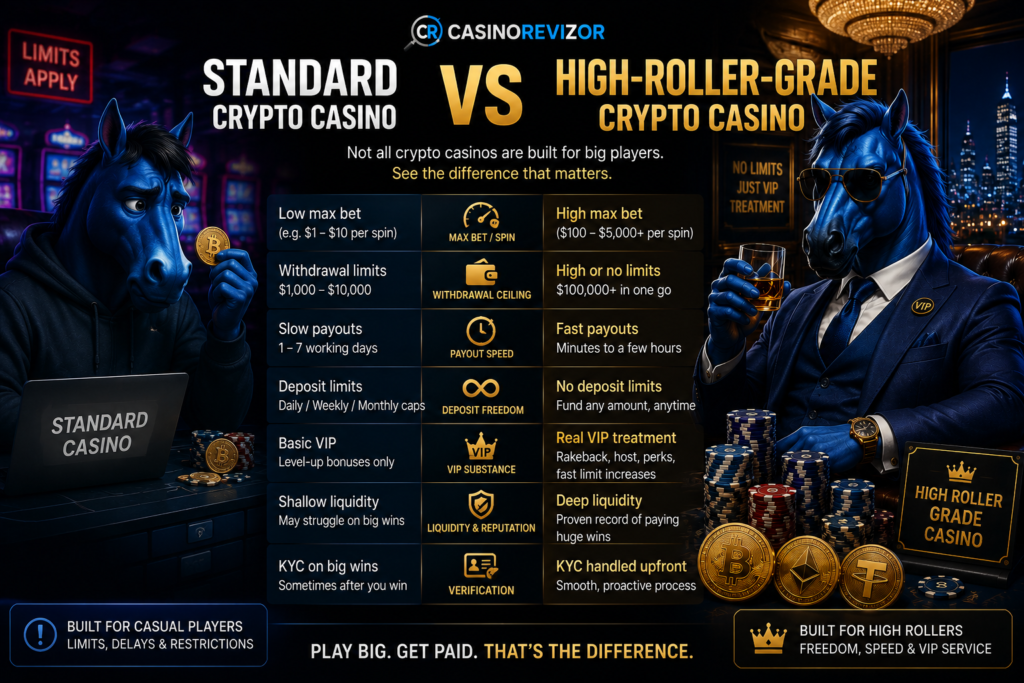
Not every crypto casino can carry high-stakes action. Judge them on this:
| Criterion | Standard crypto casino | High-roller-grade crypto casino |
|---|---|---|
| Max bet / table limits | Retail-level | High, raised further for VIPs |
| Withdrawal ceiling | Daily/weekly caps | Effectively uncapped for verified VIPs |
| Big-win handling | May stage or query | Pays large balances in one go |
| VIP programme | Generic points | Named host, bespoke rakeback |
| Liquidity | Can stall on a huge win | Deep enough for six figures |
| Support | Ticket queue | Priority / direct line |
Judge a high-roller site by its maximum bet, its withdrawal ceiling, its record of paying big wins, and whether the VIP desk is a real relationship — not by its welcome banner.
The honest trade-offs
We’d be a poor source if we only sold the upside. Going offshore for higher limits means:
- No local consumer protection. Offshore crypto casinos aren’t licensed by the UKGC, DGOJ, GGL or your national regulator. If a dispute goes wrong, the usual local routes aren’t behind you.
- Self-exclusion gaps. National schemes — GAMSTOP (UK), Spelpaus (Sweden), Spain’s RGIAJ — only cover locally-licensed sites. If self-exclusion is part of how you stay safe, offshore play is a serious gap.
- Payout reputation is your protection. Without a local regulator, the operator’s record of paying large withdrawals is your safety net.
- KYC still bites on big cashouts. “Low KYC” means low until you withdraw something large. Sort verification with your VIP host before you need it.
- Volatility and fees. Balances move with the market; many high rollers hold stablecoins to avoid it.
Security for a large balance
- Two-factor authentication (2FA) — non-negotiable on a high-value account.
- Provably fair verification where available.
- A long, clean withdrawal history — worth more than any bonus.
- Reserves and liquidity to cover a whirlwind win without stalling.
- A stable, official domain — constant domain-hopping is a red flag.
A note on tax
Tax on winnings depends entirely on where you live — tax-free in the UK, but taxable in Spain, and variable elsewhere; disposing of crypto can also carry its own tax separately from the gambling. Each of our country guides covers the local position. Keep clean records and speak to a qualified local adviser. (Not tax advice.)
Responsible gambling — please read
Higher limits and faster payouts remove the friction that protects people, which is exactly why a high roller has to build their own guardrails. This is the most important section here.
- Set hard deposit and loss limits before you play, and treat them as fixed.
- Never chase losses — a big loss is the moment to stop, not to reload.
- Mind the self-exclusion gap. Offshore sites aren’t covered by GAMSTOP, Spelpaus or their equivalents.
- Watch the warning signs — playing to escape, betting more to feel the same, hiding losses.
If gambling is causing harm, free confidential support is available: in the UK, GamCare / National Gambling Helpline 0808 8020 133 and BeGambleAware.org; elsewhere, your national helpline. 18+.
Frequently asked questions
Why are crypto casinos better for high rollers than standard casinos? Standard, locally-licensed casinos are increasingly capped — per-spin stake limits, minimum spin speeds and monthly deposit ceilings. Crypto casinos aren’t bound by those national rules, so they offer higher limits, faster large withdrawals and real VIP terms. The trade-off is that they sit outside local consumer protection.
Which countries cap how much you can stake per spin? The UK (£5, £2 for 18–24) and Germany (€1–€5 tiered from July 2026) are the clearest examples of per-spin caps. Others restrict deposits or spin speed instead.
Which countries limit how much you can deposit? Belgium (€200/week), Spain (€600/day, €1,500/week, €3,000/month), Germany (€1,000/month), the Netherlands (mandatory limits, lower for young adults) and Sweden (mandatory limit-setting) are the main examples.
Which countries restrict how fast you can play? Germany enforces a five-second minimum spin time; the UK enforces a 2.5-second minimum with no autoplay, turbo or quick-spin. Crypto casinos don’t impose these.
Where are standard online casinos banned entirely? Australia bans providing online casino games to residents under the Interactive Gambling Act 2001. Norway routes legal play through a state monopoly, and Switzerland licenses only around ten sites while blocking the rest.
Do crypto casinos have deposit or spin limits? No statutory ones. You set your own limits, which is the point for a high roller — but it also means the responsibility for limits is yours.
Are crypto casinos legal for players in restricted countries? Playing at an offshore site generally isn’t a criminal offence for the individual, but the sites aren’t locally licensed and you play outside local protection. Check the specific country guide linked above.
How fast can a high roller withdraw from a crypto casino? On a genuine high-roller site, large crypto withdrawals often settle in minutes to hours on-chain, versus 1–5 working days (and staged) at many standard casinos.
Do I still have to complete KYC at a crypto casino? Often low to start, but expect verification on very large withdrawals. Handle it proactively with your VIP host.
Are winnings taxed? It depends on your country — tax-free in the UK, taxable in Spain, variable elsewhere. Disposing of crypto can be taxed separately. See your country guide and a local adviser.
What makes a crypto casino “high-roller grade”? Higher maximum bets, effectively uncapped withdrawals for verified VIPs, deep liquidity, a real VIP host and a documented record of paying big wins.
Can I avoid affordability checks at a crypto casino? Offshore crypto casinos generally don’t run the UK-style affordability checks, but that’s a double-edged sword: those checks exist to reduce harm, so you must set your own limits.
Why did some big crypto casinos leave regulated markets like the UK? Advertising and licensing pressure led brands such as Stake to exit the UK market. Many crypto casinos remain offshore and unlicensed locally, which is why payout reputation matters so much.
Is a bigger welcome bonus the best sign of a high-roller casino? No. Judge by maximum bet, withdrawal ceiling, payout record and VIP substance — not the sign-up banner.
Which casino do you actually recommend? Of everything we’ve reviewed, Vave is the one we funded and withdrew from ourselves — our tested pick. See the full Vave review.
References and further reading
- UK Gambling Commission (UKGC) — slot stake limits, financial-risk checks, spin-speed rules
- Germany GGL (Gemeinsame Glücksspielbehörde) — GlüStV 2021 rules and 2026 stake tiers
- Belgium Gaming Commission — €200 weekly deposit limit, age 21
- Netherlands Kansspelautoriteit (KSA) — mandatory deposit limits
- Spain DGOJ — deposit caps and Royal Decree 958/2020
- Sweden Spelinspektionen — limit-setting, one-bonus rule, Spelpaus
- Australia ACMA — Interactive Gambling Act 2001
- Switzerland ESBK / Gespa — licensing and access blocking
- CasinoRevizor country guides linked throughout, and our country-by-country legality breakdown
Conclusion
For a high roller in 2026, the pattern is clear: the standard, locally-licensed casino is being built around the average player — per-spin caps, spin-speed rules, and weekly or monthly deposit ceilings that throttle serious play. Crypto casinos give that freedom back: real limits, fast large withdrawals and VIP that means something. The catch is that you step outside local protection, so the operator’s payout record becomes your safety net — and your own limits matter more than ever. Start with the country guide that fits you, choose a proven site, verify early, and play within boundaries you set in advance.
Informational only, not legal or financial advice. 18+. Please gamble responsibly.