
A few years ago, Japan had a real, visible online casino streaming scene – “オンカジ配信者” (onkaji streamers) building audiences on YouTube, Twitch, and Niconico around live slot sessions, often without showing their faces. That scene didn’t just quietly decline. It was shut down in stages, through a specific sequence of legal changes that’s worth understanding on its own terms – not just as a Japan story, but as a preview of what regulatory pressure can do to an entire content genre almost anywhere.
The Timeline
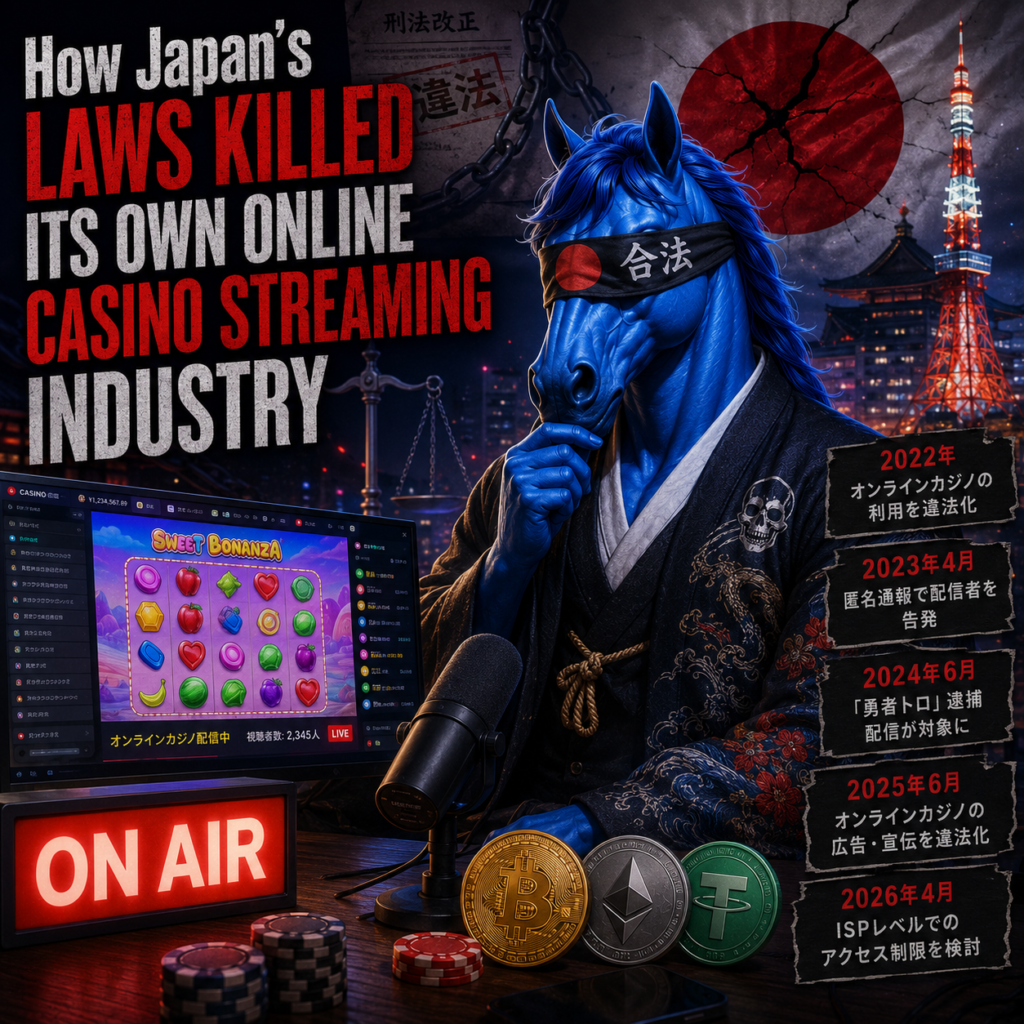
2022 – The loophole closes. Japan’s Penal Code already prohibited gambling broadly, but an amendment explicitly extended that prohibition to gambling conducted online or via telecommunications. Before this, online casino play from Japan existed in a genuine legal grey zone; after it, the activity itself was unambiguously illegal for individuals.
April 2023 – The tip that started it. An anonymous report flagged a specific streamer, known online as “勇者トロ” (Yuusha Toro), for running online casino livestreams that allegedly encouraged gambling among viewers.
June 2024 – The arrest. Yuusha Toro was arrested and referred to prosecutors, specifically over the livestreams themselves – not just personal play. This was the moment the risk stopped being theoretical for everyone else in the scene. Japanese social media response at the time coalesced around the phrase “オンラインカジノ終焉” – the end of the online casino era – with widespread predictions that more arrests would follow.
June 2025 – Advertising itself becomes the crime. This is the escalation that actually mattered most for streamers specifically. Japan passed a law explicitly criminalizing the advertising and promotion of online casinos – not just playing at one. The Japanese government’s own public messaging afterward was blunt: sites and videos that make online casinos look normal or accessible are exactly the problem the law targets, and “I didn’t know” is explicitly not a defense. For a streamer, this closed the gap that some had been relying on – the idea that showing gameplay wasn’t the same as running the casino. After mid-2025, showcasing the experience at all sits squarely inside the law.
April 2026 – Infrastructure-level blocking under study. Japan’s Ministry of Internal Affairs and Communications published a formal report from a study group examining how to restrict access to online casinos at the ISP level – moving the conversation from individual prosecutions toward blocking the infrastructure itself.
Layered together, that’s four escalating steps in four years: criminalize the play, prosecute a streamer specifically for streaming, criminalize the promotion itself, then start engineering network-level access restriction. Each step closed a gap the previous one left open.
What Happened to the Scene Itself
The practical effect matches the legal timeline. A number of channels that were active in the 2019-2023 window have since gone quiet or deleted their content outright – visible attrition rather than a gradual fade. Even names with a long public track record aren’t immune to the platform side of this: while researching this piece, we found that Kaekae’s previously active Twitch channel now returns Twitch’s standard “this content is no longer available” message, despite the channel having operated for years under an official streamer arrangement with several casino brands.
We’re not going to speculate on why any specific channel goes dark – it could be a platform-side takedown, a account closure, a shift to a different name, or something else entirely, and conflating those possibilities with legal trouble for a specific named person isn’t something we’re willing to do without real confirmation. What we can say plainly: the overall trend in the space is toward attrition, and the legal environment described above is the most obvious explanation for why.
Why This Matters Beyond Japan
Japan’s sequence is a useful case study precisely because it’s so clean: ban the activity, prosecute an example, ban the promotion of the activity, then start restricting the infrastructure. That’s a playbook other jurisdictions with strict domestic gambling monopolies could plausibly follow if political appetite exists – and a few of the countries we’ve covered elsewhere on this site (Turkey and Cambodia, for instance) show early pieces of the same pattern already in motion.
For crypto casino content specifically, Japan’s trajectory is a reminder that “the operator is licensed offshore” was never the load-bearing legal question for a streamer or a publisher based in a restrictive market – the question was always whether the promotion itself was legal where the promoter actually is. Japan just made that question explicit.
If you’re researching the platforms behind this content rather than the streamers themselves, our best crypto casino Japan ranking covers what we’ve tested and researched, and our no-KYC casinos guide breaks down which platforms keep verification light.
This article describes a real legal and cultural sequence of events in Japan. It is not an endorsement of illegal gambling or its promotion, and online casino play – and now its advertising – is illegal under Japanese law regardless of how or where it’s streamed.